Monday, October 17, 2011

Flood Barriers Hold Firm in Shielding Bangkok - ABC News

According to this news article from ABC, the residents of Bangkok are hoping that a series of dams, canals and tunnels spares the city from this year's intense flooding that has caused catastrophic damage to Thailand's rice-basket region, just upstream from Bangkok. Recent news reports have shown footage of residents in Ayutthaya using boats to travel down the city's streets.


This seems like deja vu. Exactly four years ago, I wrote this blog post: Flooding in Phitsanulok, Thailand. My wife says that her family in Ban Dong Phayom (Phitsanulok Province) has been hit hard by the flooding. Houses are raised on piles in the rural farming village where she grew up. Even so, her brothers and sisters have reported that the water level has risen enough to enter a large percentage of the elevated dwellings.

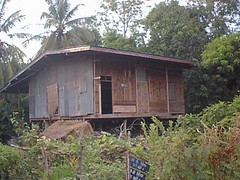
05 Another House (June 29 2000)

Typical home in Ban Dong Phayom. Photo by Kevin Borland.

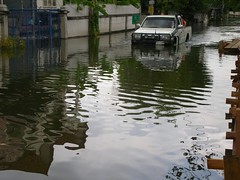
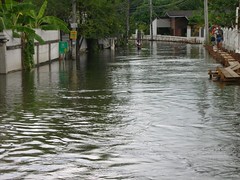
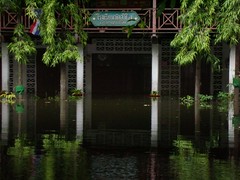
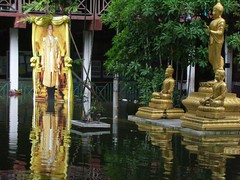
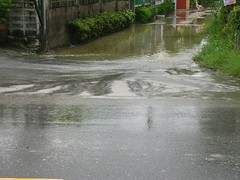
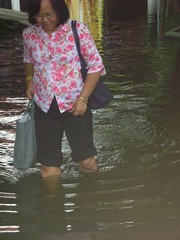
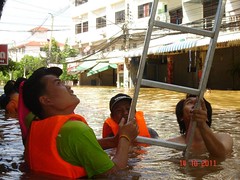
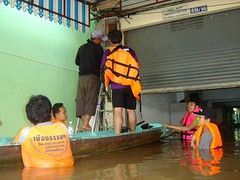
My newphew's wife just sent me these photos she took near her home in Nonthaburi. Nonthaburi is just northwest of Bangkok.

Flooding in Thailand Flooding in Thailand Flooding in Thailand Flooding in Thailand Flooding in Thailand Flooding in Thailand Flooding in Thailand Flooding in Thailand

Saturday, October 15, 2011

My Direct Paternal Ancestry

Growing up, I knew very little about my direct paternal ancestry. I first met my paternal great grandfather Weldon Earl Borland after the death of my grandfather John Earl Borland in 1986. After college, I began working on creating a family tree, beginning with information I obtained from interviewing Weldon. I have since continued compiling information regarding the history of the Borland family, and recently had my Y chromosomal DNA tested. The following is the history of my paternal ancestral line, generation by generation:

Generation 1: Kevin Borland

I was born January 20, 1975, in Jersey City, New Jersey, to parents Steven Thomas and Kathleen (Szczesny) Borland. Shortly after my birth, my family moved to Morris County, New Jersey, where we lived for three years before relocating further northwest to Hardyston, Sussex County.
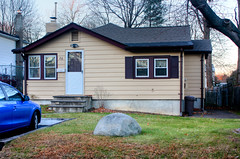
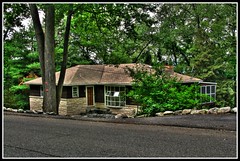
My Childhood Home in Lake Hiawatha My Childhood Home in Scenic Lakes, New Jersey

My childhood homes in Lake Hiawatha, Morris County (left) and Hardyston, Sussex County (right)

I currently reside in Arlington, Virginia, with my wife Thidawan and my stepson Jaras. I am an attorney by profession.
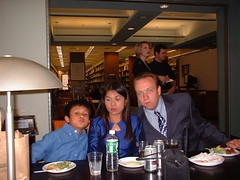
01 Jaras Thidawan & Kevin Eating

Kevin Borland family

Generation 2: Steven Thomas Borland

My father was born August 7, 1950, also in Jersey City, to parents John Earl and Helen Eloise (Freudenberg) Borland. He grew up in Jersey City, and remained in New Jersey until retiring to Florida about 10 years ago. Steven served in the United States Army, and was deployed to Germany during the Vietnam War. Upon his return to New Jersey, he worked for the United Parcel Service (UPS) most of his life, until he began suffering from leukemia. He died in Tampa June 15, 2010, from complications arising from a bone marrow transplant, after which he was buried in Leesville, Ohio, a few rows away from his father's grave.

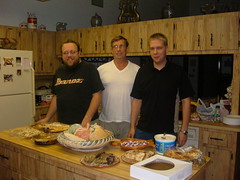
Steven Thomas Borland 45 Kevin Dad and Steven (November 25 2004)

Steven Thomas Borland's high school yearbook photo (left) and pictured with his two sons Kevin and Steven in Florida (right)

Generation 3: John Earl Borland

John Earl Borland was born May 16, 1924, in the now-defunct village of New Hagerstown, Carroll County, Ohio, to parents Weldon Earl and Elizabeth Marie (Forbes) Borland. John's parents divorced prior to his birth, and John was raised by his mother Elizabeth on her parents' farm in New Hagerstown. John served in the United States Navy during World War II, after which he relocated to Jersey City, where he met his first wife, my grandmother Helen. John worked most of his adult life at the Ballentine Brewery in Newark, New Jersey. John and Helen eventually divorced, and John remarried to Geraldine (Winblad) Van Deusen. Upon John's retirement, he returned to Ohio with Geraldine, where he died of lung cancer, November 10, 1986.

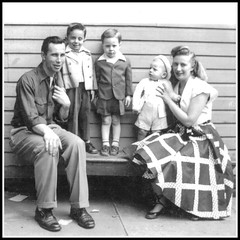
John Earl Borland (1924-1986) Borland Family

John Borland's high school graduation photo (left) and pictured with wife Helen, stepson Michael and sons John and Steven (right)

Generations 4: Weldon Earl Borland

Weldon Earl Borland was born July 3, 1906 in Bowerston, Harrison County, Ohio, to parents James Couthren and Lizzie Alberta (Miller) Borland. Weldon grew up in Bowerston, but as an adult relocated to Akron, Ohio, where he worked for Goodyear. After some time, he left Goodyear and started his own business called "Volume Sewing." Weldon and his employees manufactured a variety of sewn items ranging from army uniforms to boat covers. Weldon married briefly my great-grandmother Elizabeth Marie Forbes, and later Vivian Kniseley. My great-uncle Jeffrey James Borland is a son from Weldon's second marriage. Weldon died March 2, 2002, while he was hospitalized for treatment of pneumonia, and was buried in Long View Cemetery in Bowerston, as are both of his parents. He was 95 years old at the time of his death.
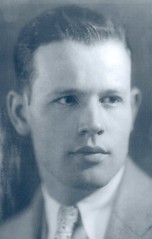
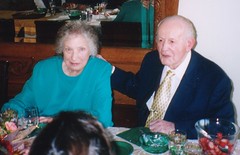
Weldon Earl Borland Rose Simmons and Weldon Borland

Weldon Borland in his youth (left) and later in life pictured with his long-time companion Rose Simmons (right)

Generation 5: James Crouthen Borland

James Crouthen Borland was born September 25, 1877, also in Bowerston, to parents James II and Catherine Jane (Walker) Borland. He was the owner of "J.C. Borland Wholesale and Retail," a general store in Bowerston. James and wife Lizzie Alberta (Miller) Borland had four children, two of which survived to maturity, my great-grandfather Weldon, and his sister Ruth Eleanor Borland. James died April 19, 1943 in Bowerston, of a cerebral hemorrhage secondary to chronic alcoholism. At the time of James' death, he and Lizzie were divorced.
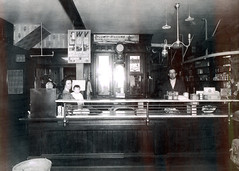

Borland Family Store J.C. Borland Wholesale and Retail

James Borland and family behind the counter at J.C. Borland Wholesale and Retail (left), and James' letterhead (right)

Generation 6: James Borland II

James Borland II was born October 2, 1835 in Orange Township, Carroll County, Ohio, probably in or near New Hagerstown. His parents were James and Mary (McQuiston) Borland. He married Catherine Jane Walker and they had two children, Charles Oliver Borland (1871-1931) and James Crouthen Borland (1877-1943). James was a farmer by occupation, and he served as a volunteer soldier in the United States Civil War. His Civil War rifle remains in the family. James died May 11, 1903 in Bowerston.
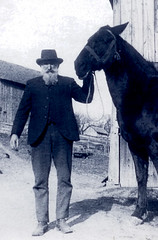
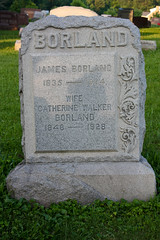
James Borland II (1835-1914) James and Catherine (Walker) Borland

James Borland II with his horse (left), grave of James and Catherine Borland at Long View Cemetery (right)

Generation 7: James Borland

James Borland was born 1792 in or near Westmoreland County, Pennsylvania, to parents Samuel and Lydia (Gregg) Borland. He married Mary McQuiston of Butler, Pennsylvania, with whom he fathered at least six children. A McQuiston family history states that James was a music teacher in his youth. Census data reveals that he was a farmer, later in life. James lived until at least 1850, although his grave has not been located. It is suspected that he may be buried in New Hagerstown.

Generation 8: Samuel Borland

Samuel Borland was born 1748 in County Antrim, Northern Ireland, to parents John and Rachel Borland. After immigrating to the United States prior to 1783, he married Lydia Gregg in Pennsylvania and had 11 known children. Samuel and his family resided in Manor of Denmark, near Export, Westmoreland County, Pennsylvania, since at least 1800, where Samuel built the first stone house in the Manor Valley. Samuel died 1811, after which Lydia obtained a land patent in Carroll County, Ohio, where subsequent Borland generations settled. Samuel and Lydia are buried in Congruity, Salem Township, Westmoreland County. Lydia's suspected brother David Gregg was a great-grandfather of United States President Harry S Truman.
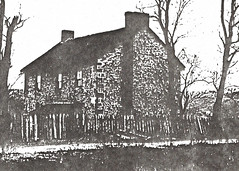
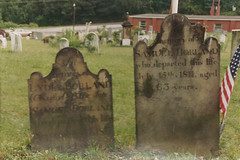
Borland Residence in Pennsylvania Samuel and Lydia Borland Graves

Samuel Borland residence in Manor of Denmark (left), Samuel and Lydia Borland graves (right)

Generation 9: John Borland

Based on the year of his first marriage (1738), John Borland must have been born prior to 1720. Based on the names of his children, his father was likely named James. John was the progenitor of the Borland family of the Kilraughts Parish in County Antrim. He first married a woman by the name of Ann in Lisburn, by whom he fathered four children. After Ann's death, prior to 1745, he remarried to a woman named Rachel, widow of a Mr. Moore, by whom he fathered an additional 9 children. While some of the children immigrated to the United States, others remained in and around Kilraughts. John was a farmer by occupation. He died around 1778 in or near Kilraughts. The location of John's birth is presently unknown, although one might speculate that since he first married in Lisburn, he was probably born somewhere in the vicinity of Belfast.
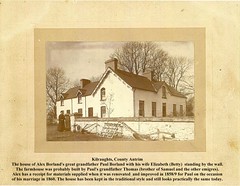
Borland Home in Kilraughts, Ireland

Borland residence in Kilraughts

Generation 10: James Borland

The name James is based on the fact that John Borland (of generation 9) named his first-born son James. The custom at the time, both in Scotland and Northern Ireland, was to name one's first-born son after the child's paternal grandfather. James would have been born circa 1685, probably in or near Belfast. In addition to his son John of Kilraughts, he also fatherd a son Andrew who resided in Ballymoney. My direct line of paternal ancestry can only be traced as far as this 10th generation using conventional genealogical methods, i.e. through the discovery and review of historic documents, gravestones, published family histories, etc.

Generations 11-12: Borlands of Belfast

The similarity between my Y-DNA and the Y-DNA of David Hunter Borland of Pittsburgh, Pennsylvania, suggests that the Borlands of Clondavaddog, County Donegal, descend from a very close relative of James Borland (of generation 10). Furthermore, based on the small number of Borland families in Ulster (the northernmost of Ireland's 4 provinces) enumerated in the 1796 list of Irish flax growers, clustered almost entirely near Clondavaddog and Ballymoney, it would appear that either James' father or grandfather was likely the immigrant ancestor of all of the early Borland families of Ulster, having come to Belfast from Scotland (Borland being a Scottish surname). According to the Wikipedia Article entitled "History of Belfast," after the Irish Rebellion of 1641, many Scots who had come to Ulster as part of the Scottish army sent to put down the rebellion, settled in Belfast after the Irish Confederate Wars." A Borland ancestor of about the 12th generation would have been just the right age (having likely been born around the 1620s) to have been one of the Scottish soldiers.

Generations 13-15: Borlands of Strathclyde

According to Ancestry.com, my closest Y-DNA match (using 46 short tandem repeat markers) is to a Randy Scott Borland, who, like me, resides in Northern Virginia. Ancestry.com estimates that we are probably related within 15 generations. Although I have been thusfar unable to contact Randy, I independently constructed his family tree. Upon doing so, I learned that he descends from a line of Borlands that straddles the parishes of Galston and Loudoun, in the Strathclyde region of Scotland. His Borland line does not pass through Ireland. This suggests that that our distinct branches of the Borland family both descend from a common Borland ancestor who lived in the Strathclyde region of Scotland, possibly born around the 1530s (based on an average generation gap of 30 years). Unfortunately, the church records of Galston and Loudoun only go back to the 1680s, where in Loudoun, for example, in 1684 a child named Anna was baptized, with the name Archiblad Borland listed as her father.

Generations 16-18: Origin of the Borland Surname

In Ancestry.com's ranking of genetic separation of Y-DNA donors, once we reach STR matches estimated within approximately 19 generations, all matches have surnames other than Borland. This suggests that the Borland surname was adopted in my direct paternal line between generations 16 and 18. Again using an estimated average generation gap of 30 years, that brings us to the time period between the 1440s and 1500s. My first ancestor to have used the name Borland would have spoken an Anglic language, probably either Scots or Middle English (ancestral to the modern English language).

Generations 19-21: Beyond Borland and Beyond Scotland

STR matches estimated to converge with my paternal lineage at generations 19 and 21 carry the surnames Shaw and Fielder, respectively. Both of these surnames, like the name Borland, are of Anglic origin, suggesting that the Borlands, Shaws and Fielders, shared a common Anglic-speaking direct paternal ancestor born around 1350, who likely lived in England (since Shaw and Borland are Scottish names, whereas Fielder, a line which split off from my lineage earlier is of English origin). Interestingly, all three names are also topographic surnames. It would appear that the names Borland, Shaw and Fielder were adopted by three branches of the same family, prior to which (before generation 18) the family may not have employed the use of a surname. The migration from England to Scotland likely occurred around generation 20.

Generation 22: Brief Passing Through Cornwall

A 12/12 STR match, found on ySearch.org, with an individual bearing the surname Pennock suggests a 90% chance of a direct paternal relation within 23 generations. Pennock is a Cornish name, indicating that the Borland paternal ancestor born around 1320 may have lived in Cornwall, in southwestern England. Pennock, once again, is a topographic surname, deriving its name from Pignocshire (pronounced with a silent "g") in Cornwall.

Generation 23: From Gascony to England During the Hundred Years' War

Another 12/12 STR match from ySearch.org reveals a link within 23 generations to an individual with the surname "de Ayala" who has traced his paternal line back to Gascony, a historically Basque region in southwestern France. "De Ayala" is another topographic surname originating in Ayala, a village in Basque Country, Spain. This suggests that my 20x great-grandfather, born around the year 1290, lived among the Basque, in either northwestern Spain or southwestern France. I suspect he resided in Gascony, since that would explain the migration in the next generation or so to Cornwall. This has to do with the Edwardian War being fought in Gascony from 1337-1360 (the first phase of the Hundred Years' War). At that time, Gascony was English territory. It would not be surprising if some citizens of Gascony may have moved to other, perhaps more peaceful, English territories during the war. Cornwall is the closest portion of present-day England to Gascony, geographically, perhaps making it an obvious choice for my ancestor, even if the trip was almost 700 miles by sea. If this theory is correct, than the name "de Ayala" may have been the surname used by my direct paternal ancestors prior to the adoption of an Anglic language. This would explain the various Anglic topographic surnames used by different branches of the family in later generations. Perhaps each branch of the family switched from "de Ayala" to a new Anglic topographic surname upon adoption of an Anglic language. This would also explain why the surname Borland seems to have arisen at a time long after surnames were being commonly used in Scotland.

Generations 24-28: Basque Country

A more distant STR match, estimated by Ancestry.com to converge with my paternal lineage at generation 28 (mid 12th century), further supports a Basque Country homeland of the paternal ancestors of the Borlands. At this level, the surname Zurita is added to the list of surnames sharing a common paternal origin. Zurita is an Aragonese surname, originating in northern Spain. Y-DNA STR analysis appears to indicate that my direct paternal line resided in the Pyrenees by the 13th century, where Navarro-Aragonese languages were spoken, in addition to Basque. Muslims would have been more likely to have spoken the Navarro-Aragonese languages, since they did not descend from the indigenous Basque people.

Generation 29: Salamanca to Basque Country

A 31/37 STR match in the Sorenson Molecular Genealogy Foundation database with an individual with the topographic surname Bejar suggests my paternal ancestral line may have resided in or near Salamanca in the 29th generation. Béjar is the name of a town in Salamanca. The migration from Salamanca to the Basque Country in the Pyrenees was likely a result of the Reconquista, a gradual process in the Middle Ages during which several Christian kingdoms succeeded in retaking the Muslim-controlled areas of the Iberian Peninsula broadly known as Al-Andalus. The paternal ancestors of the de Ayala/Borland family , were likely Muslims (Moors) who retreated to the mountains in northwestern Spain as a result of the Reconquista. (See below for evidence supporting this theory.) According to Wikipedia, "The main phase of the Reconquista was completed by 1249, after the Battle of Las Navas de Tolosa, when the sole remaining Muslim state in Iberia, the Emirate of Granada, became a vassal state of the Christian Crown of Castile." This fits very well into our generational timeline. The animated map below, provided by the Norwegian historian Tolke, depicts the timeline of the Reconquista. The retracting green portion of the animation represents the portion of the Iberian Peninsula dominated by the Moors.


Generations 30-34: One Hundred Fifty More Years in Spain

Continuing on through generation 34 (early 10th century), the surnames Salinero, Levario, Rodriguez and Bermudez appear among my STR matches, indicating the presence of my paternal line in Spain for over two centuries. Based on these patronymic and occupational surnames, however, a precise region in Spain cannot be identified.

Generations 35-40: Two More Centuries in Spain

Beyond 35 generations, STR comparison ceases to be a particularly useful method of tracing paternal migration, and we must turn to single-nucleotide polymorphism. While I have not personally taken a deep SNP y-dna haplogroup test, fortunately, my approximately 30th paternal cousin Armondo C. Rodriguez has. His results reveal that he, as well as the Borlands, are of y-DNA haplogroup E1b1b1b1b (M183), indicating recent North African ancestry. We then turn to the history of Spain, and discover that in the early 8th century (around generation 40 on our timeline), nearly all of the Iberian Peninsula was conquered (711–718) by largely Moorish Muslim armies from North Africa. The Moors referred to the conquered peninsula as Al-Andalus. My paternal 37x great-grandfather would have spoken Andalusian Arabic.
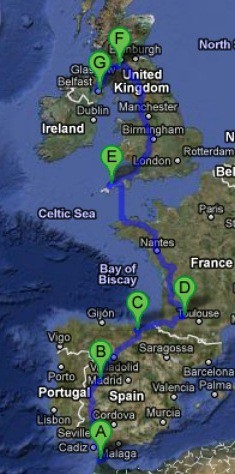
Borland Migration

Map showing migration route from Northern Africa to Northern Ireland, as discussed thusfar, with nodes at A: Morocco, B: Salamanca, C: Basque Country, D: Gascony, E: Cornwall, F: Strathclyde and G: Ulster.

Generations 41-185: Over Four Thousand Years in the Maghreb

Y-DNA haplogroup E1b1b1b1b (M183) is believed to have emerged in the Maghreb, or northwestern Africa, around 5,600 years ago, which would suggest that my paternal ancestors spent over 4,000 years living in the Sahara. M183 is sometimes referred to as the Berber marker, since in some groups of Berbers, nearly 100% of the population exhibit this mutation. The Moors who invaded Spain were largely of Berber ethnicity.

Generations 186-750: From the Nile to the Sahara

Haplogroup E1b1b (M215), ancestral to E1b1b1b1b (M183) is believed to have emerged in eastern Africa, around 22,400 years ago, perhaps along the Nile in present-day Ethiopia or Sudan. 750 generations ago, my direct paternal ancestor may have spoken an ancient language, ancestral to the modern Nilo-Saharan languages.

Generations 751-1200: From the Ethiopian Highlands

Haplogroup E1b1 (P2/PN2), ancestral to E1b1b (M215) is believed to have emerged in the Ethiopian highlands, around 35,000 years ago. 1200 generations ago, my direct paternal ancestor may have spoken a language not only ancestral to the Nilo-Saharan languages, but also to the Niger-Congo and Mande languages.

Tuesday, October 11, 2011

The Maasai of Kenya

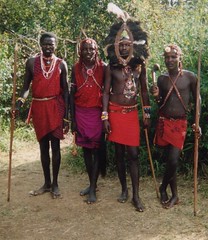
The Maasai are an ethnic group of semi-nomadic people located in Kenya and northern Tanzania. They are among the best known of African ethnic groups, due to their distinctive customs and dress and residence near the many game parks of East Africa. I came across these four Maasai tribesmen in Nairobi National Park, Keyna.

Maasai DNA

Recent studies of Maasai DNA reveal a complex history of the Maasai people. In 2005, Elizabeth Wood, et al., sampled the Y-DNA of 26 Maasai tribesmen, and from this sample determined that 50% of the individuals had Y-DNA of Haplogroup E1b1b1 (M35), 27% had A3b2 (M13), 16% had E1b1a1 (M2), and 8% B2a (M150). An explanation of each, in the context of the history of the Maasai, follows.

Eastern Sudanic Ancestry

The largest Y-DNA found among the Maasai sample, E1b1b1, represents Eastern Sudanic ancestry (although it is also associated with certain other "Nilo-Saharan" populations). One would expect to see a high percentage of this haplogroup based on the fact that the Maasai speak a Nilotic (Eastern Sudanic) language. However, based on the fact that only 50% of their DNA is Eastern Sudanic, it would appear that the Maasai are remnants of an older culture whose language went extinct after prolonged contact and interbreeding with Nilotic peoples. Examining the other components of their Y-DNA is the key to understanding the origin of the Maasai.

Niger-Congo Ancestry

Haplogroup E1b1a1 represents a component of the Masaai ancestry common among most Sub-Saharan populations, indicating Niger-Congo ancestry. The most likely source of this haplogroup is the Bantu expansion, whereby Bantu-speaking peoples spread across Sub-Saharan Africa from East to West, generally. However, this haplogroup does not reveal the ancient origin of the Masaai people.

Pygmy and Khoisan Ancestry

It would appear that prior to the Bantu expansion and the southward migration of the Nilotic peoples, the Maasai were a combination of Pygmy and Khoisan people, assuming that haplogroup B is the African Pygmy modal haplogroup and A3b is the Khoisan or "Bushman" modal haplogroup. The deep components of Masaai DNA suggest an admixture between the most divergent branch of the Pygmies and the most divergent branch of the Khoisan. Most Pygmy populations exhibit a significant percent of the B2b clade, whereas the Maasai exhibit the B2a sister clade. Most Khoisan peoples exhibit a significant percent of the A3b1 clade, whereas the Maasai exhibit the A3b2 sister clade. It would appear that the distant ancestors of the early Maasai (excluding recent Supra-Saharan admixture) were a mixture of members of two ancient African hunter-gatherer cultures. The spread of Nilotic and Bantu culture wiped out the entire language families of the component populations, although the Maasai maintained much of their ancient nomadic culture.

Maasai DNA Reveals Origins of Sandawe People

Until recently, the Sandawe people, although living in Tanzania, were considered to be closely related to the Khoisan ethnicities of the Kalahari desert. Much of this presumption was based on the fact that like the Kalahari Bushmen, the Sandawe speak a click language. However, in 2007, Sarah Tishkoff, et al., conducted a study on the Y-DNA of 68 Sandawe people. The results were more complicated than even the Maasai. However, excluding the 56 individuals who tested for Supra-Saharan Y-DNA (Eastern Sudanic and Niger-Congo haplogroups described above), the remaining 12 individuals exhibited 72% haplogroup B2b (M112), 22% haplogroup A3b2 (M13) and 6% B2a (M150). Note the 22:6 ratio of A3b2 to B2a, comprared with the nearly identical 27:8 ratio among the Maasai. This suggests that the Sandawe were originally B2b pygmies, with subsequent admixtures from (not necessarily in this order) the Maasai, Bantus and Nilotics. Unlike the Maasai, however, the Sandawe retained their ancient click language. Since the Hadza people of Tanzania are the nearest B2b click-speaking tribe, one could presume that the language of the Sandawe is distantly related to the Hadza language, both languages perhaps descending from a common language spoken by the original Pygmy who underwent the B2b Y-DNA mutation. That would mean that the only extant "true" A3b1 Khoisan languages are those click-languages spoken in and around the Kalahari desert.

Implications Beyond Sub-Saharan Africa

According to the most recently accepted version of the mt-DNA phylogenetic tree, it is believed that the first split occurred separating the Khoisan L0 clade from the L1-6 superclade (representing the founding populations of the speakers of all non-Khoisan languages). In the non-Khoisan superclade (represented by haplogroup BT in the Y-DNA phylogenetic tree), the first node appears to separate the African Pygmies from the ancestor of the speakers of all non-Khoisan and non-pygmy languages. This split corresponds to the split between B and CT in the Y-DNA tree. It is interesting that both the haplogroup A Khoisan languages and the haplogroup B Pygmy languages are click languages, and that CT (which is downstream from BT) is the only clade originating in this time period not dominated by click languages. This is some evidence, although not conclusive, that there may have been at one time a Proto-World language that had clicks among its sound inventory, ancestral to all modern languages, including the CT languages (including Enlgish, for example). That is to say, perhaps around 75,000-100,000 years ago, all languages had clicks, and the Supra-Saharan CT branch lost its clicks. An analogy would be the English language having lost grammatical gender despite its Indo-European origin.

References

History of Click-Speaking Populations of Africa Inferred from mtDNA and Y Chromosome Genetic Variation. Tishkoff, Sarah A. et al 2007.

Contrasting patterns of Y chromosome and mtDNA variation in Africa: evidence for sex-biased demographic processes. Wood, Elizabeth T et al 2005.

Sunday, October 2, 2011

Basque Y-DNA

Basque Y-DNA

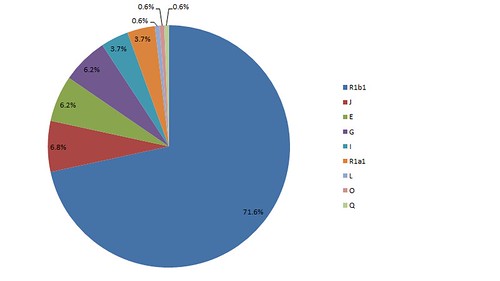
The above chart includes data from 162 male volunteers who submitted their Y-chromosomal DNA results to Family Tree DNA's Basque DNA project. Individuals who submitted their Y-DNA results claim to be of direct male Basque descent. Contributing volunteers included residents of Europe, Asia, and North and South America. Analysis of the data reveals that 71.6% of the participants in this study carry Y-DNA of haplogroup R1b1 and its subclades.

Basque People

The Basques as an ethnic group, primarily inhabit an area traditionally known as the Basque Country, a region that is located around the western end of the Pyrenees on the coast of the Bay of Biscay and straddles parts of north-central Spain and south-western France. Since the Basque language is unrelated to Indo-European, it is often thought that they represent the people or culture who occupied Europe before the spread of Indo-European languages there.

Y-DNA in the Field of Linguistics

Y-DNA haplogroup testing is a valuable tool in the study of historical linguistics. Y-DNA is carried from father to son, and mutates at a somewhat predictable rate. Haplogroups are clades of DNA types that share a distinct defining mutation or mutations. Each such mutation occurred in a single person at some point in the past. Since the person in which that mutation occurred necessarily spoke a language (at least in the time-frame of the past 50,000 years or so), and since a large percentage of children learn to speak the same native language as their father, one can use Y-DNA studies to track the historical evolution of languages, and uncover ancient relationships between living language families, to a surprising degree of accuracy.

When using Y-DNA as a tool to discover relationships between living language families, however, one must take into account the fact that there are several reasons why children may not learn to speak the native language of their fathers. The most obvious of such a situation is when the father either moves to a region that speaks a different language or has a child in a region where another language is dominant in addition to his native language (i.e., a more dominant local language is taught in schools, used in business, etc.), and rather than learning the native language of the father, children adopt the local language.

The goal in interpreting the data from this study is to determine which, if any, of the individuals whose Y-DNA first contained the defining mutations of the haplogroups, may have spoken a language ancestral to modern Basque, i.e. "Ancient Basque."

Haplogroup E Among Basque People

93.8% of those tested reported haplogroups of Eurasian origin, whereas 6.2% reported haplogroup E and its subclades. Haplogroup E is common among ethnic groups which originated along northern portions of the Nile River in Africa, including speakers of Nilo-Saharanm, Niger-Congo, Mande and certain Afro-Asiatic languages. The infusion of Y-DNA haplogroup E among the Basque population likely took place long after speakers of the ancestral Basque language arrived on the Iberian Peninsula, perhaps after the Afro-Asiatic speaking Moors invaded southern Europe. That is to say, the Basque language is unlikely to share a common origin with the Nilo-Saharan or Afro-Asiatic language families, although males of Northern African descent who migrated north to the Iberian Peninsula apparently interbred with women of the Basque population, perhaps influencing the local "Ancient Basque" language, but not replacing it.

Outliers in Haplogroups L, O and Q

Of the 162 individuals tested, there was one individual who carried haplogroup L, one who carried haplogroup O, and one who carried haplogroup Q. These haplogroups are of Eurasian origin, but are probably not associated with speakers of Ancient Basque. The individual who carried haplogroup Q resided in China and reported that his most distant known paternal ancestor resided in Mexico and had a Basque surname. It should be noted that Y-DNA haplogroup Q is the most common haplogroup among native (non-European) Mexicans, and not likely indicative of a Basque origin, despite the Basque surname. Haplogroups L and O generally correspond with South Asian and Asiatic languages, respectively. As the present-day Basque language shares little in common with members of these well-studied language families, the individuals likely represent a very small segment of the Basque population who descend from recent (less than 5000 years ago) immigrants to the Basque country from southern and eastern Asia.

Haplogroup R1a1 on the Iberian Peninsula

While haplogroup R1a1 appears in this sample at a percentage of 3.7%, that rate is similar to, if not less than, the occurrence of R1a1 in surrounding regions. R1a1 likely corresponds to DNA of native speakers of Indo-European languages, who settled the Iberian Peninsula and likely wiped out all recent branches of the Ancient Basque language with the exception of the languages of the Basque country. Haplogroup R1a1 is found in all locations where Indo-European languages are spoken, and the person in which its defining mutation occurred likely spoke a language ancestral to Indo-European, not to Basque.

Northwest Caucasian Haplogroup G

Y-DNA haplogroup G has not been definitively associated with any living language family, although it is common among speakers of Northwest Caucasian languages. The language of the progenitor of haplogroup G may only be manifested in the Northwest Caucasian substrate which differentiates the Northwest from the Northeast Caucasian languages. Since there are unlikely any modern surviving languages that descend directly from the language spoken by the progenitor of haplogroup G, it is difficult to rule out the haplogroup as corresponding to an Ancient Basque precursor. However, due to the overwhelming majority of haplogroup R1b1 (which shares the same lack of known modern surviving descendant languages) among the Basque population, it seems logical that many carriers of haplogroup G may have spoken a Vasconian (pre-Basque) language (perhaps since as long as 10,000 years ago), after native Vasconian speaking carriers of R1b1 dominated their native culture, perhaps shortly after the last ice age.

Cro-Magnon Haplogroup IJ

10.5% of the sample reported haplogroups of either I or J, both haplogroups that represent subsequent mutations from an earlier Cro-Magnon haplogroup IJ, which appears to have originated in the Caucasus. This is a large percentage of the sample that cannot be discounted. The progenitor of haplogroup J may have spoken a language ancestral to the Northeast Caucasian and Kartvelian language families. The progenitor of haplogroup I spoke a language belonging to an extinct family that may only have modern observable manifestation in the substrate of vocabulary found in the Germanic languages (approximately 1/3 of the lexicon) that is not traceable to Proto-Indo-European origin. While neither haplogroups I nor J can be definitively ruled out as corresponding to the Basque language, it appears that the Basque language does not share much in common with the Northeast Caucasian or Kartvelian languages, nor have I found any source that suggesting that its lexicon overlap the Proto-Germanic substrate.

Vasconian Haplogroup R1b1

Based on the data from this study in a vacuum, it seems very likely that if the progenitors of any of these haplogroups spoke a Vasconian language, it should be R1b1, as R1b1 accounts for 71.6% of the sample population. However, looking outside this study, R1b1 is equally common among most Indo-European speaking (Spanish and Portuguese, e.g.) populations of the Iberian peninsula, and almost as common in regions to the east where other Romance languages are spoken such as French and Italian. Perhaps remnants of the language spoken by the progenitor of R1b1 can be found by studying the differences between the Romance (Italic) brancih of the Indo-European languages from other Indo-European subfamilies. I suspect some of the differences may be accounted for by a Vasconian substrate that represents linguistic elements of other languages descended from Vasconian that may have been spoken by populations who assimilated into the western Indo-European culture, and adpoted Indo-European as their language. I believe this hypothesis is more sound than a IJ origin of the Basque language, based on geographic data on the present location of haplogroup R1b1 vs. haplogroups I and J. For example, haplogroup I is distributed widely in Scandinavia and in regions where Germanic languages are spoken. It seems likely that if there was a living descendant language of the language spoken by the progenitor of haplogroup I, it would have the highest likelihood of surviving in Germanic speaking Europe, not in the Pyrenees Mountains where R1b1 y-DNA is dominant among Italic speakers who (if they inherited their language from their ancestors rather than by assimilation) would be expected to have R1a1 Indo-European DNA.

Basque Language Isolate

One might ask, if the Basque language is associated with R1b1, and the Indo-European languages are associated with R1a1, (both clades of R1), why is the modern Basque language so different from all of its closest genetic relatives? However, consider, for example, the incredible difference between the English and Hindi languages (both Indo-European) which probably only diverged from their most common ancestor about 5,000 years ago. If not for available linguistic data from the numerous other languages in the Indo-European family, one might be highly skeptical about their common origin, especially due to the geographic distance where the two languages are spoken, and the differences in culture, appearance, religions, etc., between the populations by whom they are spoken. One must keep in mind that R1a and R1b diverged from their common y-DNA ancestor R1 approximately 18,000 years ago, and there are no intermediate languages on the R1b side that survived to modern times, with the possible exception of Basque. It should not be surprising that Basque seems completely foreign to the Indo-European languages, in this context.

Furthermore, even if the progenitor of R1a spoke an ancient Indo-European language and the progenitor of R1b spoke an ancient Vasconian language, that does not necessarily imply that the two ancient languages were closely related. The progenitor of R1 (ancestral to R1a and R1b) probably lived in Siberia some 25,000 to 30,000 years ago, approximately 10,000 years prior to the mutations that occurred that created the subclades of R1a and R1b. In those 10,000 years, the descendants of the progenitor of R1 may have come to speak many languages unrelated to the the native language of their ancestor by means of assimilation as they migrated across Asia. That is to say, while R1a and R1b carriers are undoubtedly genetically related, an inter-disciplinary approach including efforts by experts in the fields of anthropology, archaeology, linguistics, genetics, philology and other sciences, is required to prove or disprove any ancient relation between the Basque language and the Indo-European languages. Also, an examination of the Burushoski language spoken by (among others) descendants of R1's closest relative R2 may provide some evidence helpful to determining the origin of the Basque language. Unfortunately, Burushoski, spoken in portions of present-day Pakistan, is also a language isolate.

Related Reading

For what they were... we are: Linguistic musings: Basque and Proto-Indoeuropean

Diagram, research and analysis by Kevin Borland. Data provided by Family Tree DNA. Text of subsection "Basque People" derived from Wikipedia.

Sunday, September 25, 2011

Roger Clyne at the State Theatre

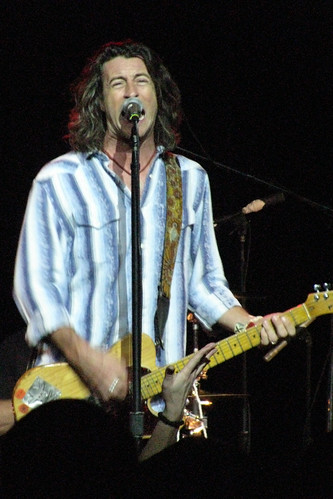
Roger Clyne

Roger Clyne and the Peacemakers performed September 25, 2011, at the State Theatre in Falls Church, Virginia. They played the following songs:

1. All Over the Radio

2. Down Together

3. Heaven on a Paper Plate

4. Banditos

5. Dinero

6. Mexico

7. Lemons

8. Marie

9. Tell Yer Momma

10. Maybe We Should Fall in Love

11. Interstate

12. Paper Airplanes

13. Wanted

14. I Know You Know


15. Girly

16. Yahoos and Triangles

17. Empty Highway


18. European Swallow

19. Mekong


20. Green and Dumb (encore)

21. Counterclockwise (encore)

22. Nada (encore)

Photo and videos by Kevin Borland.

Saturday, September 24, 2011

Trip to the Zoo

I took my mother to visit the National Zoo today. I have visited the few a handful of times before, but this time I spent quite a bit of time in the Small Mammal House. Here are a few of the animals we saw:

White-Faced Saki

The white-faced saki, also known as the Guianan saki and the golden-faced saki, is a species of saki monkey, a type of New World monkey, found in Brazil, French Guiana, Guyana, Suriname, and Venezuela. This species lives in the understory and lower canopy of the forest, feeding mostly on fruits, but also eating nuts, seeds, and insects.

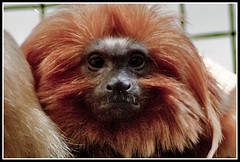
Golden Lion Tamarin

The golden lion tamarin is diurnal and primarily arboreal, forming small groups of patrols with a consistent territory of around 400,000 square metres (100 acres). Fighting between groups is avoided by scent marking and ritual encounters. By night, the tamarins sleep in abandoned nesting holes in trees, or in large bromeliads.

White-Faced Saki Golden Lion Tamarin

Pale-faced saki (left), golden lion tamarin (right). Photos by Kevin Borland. Portions of text derived from Wikipedia.

Sunday, September 18, 2011

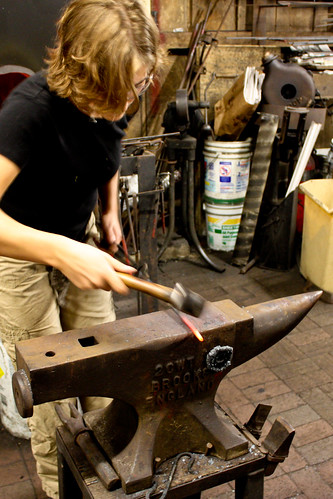
Blacksmith at Gulf Branch Forge

Blacksmith at Gulf Branch Forge

I wanted to get out of the house today, so I went over to the Gulf Branch Forge, where I met this friendly blacksmith. I watched her make an ornate hook out of a steel rod. First she made each end of the rod pointed and rounded using the hammer and anvil. Then, she bent one of the ends into a spiral for decoration. Next, she formed the hook portion by wrapping the bar around a circular piece of metal. Then, she bent the straight end at a 90 degree angle so it could be hammered into a wall. She then proceeded to twist the middle of the hook (between the 90 degree angle an the curved portion) for a decorative effect. Finally, she straightened it and polished it. The piece was finished about a half hour from when she first placed the rod in the forge. While she was making the hook she explained every step of the process, and discussed everything from how the coal forge works to how lasers are used to check the insulation on modern gas forges.

Photo by Kevin Borland.

Sunday, November 21, 2010

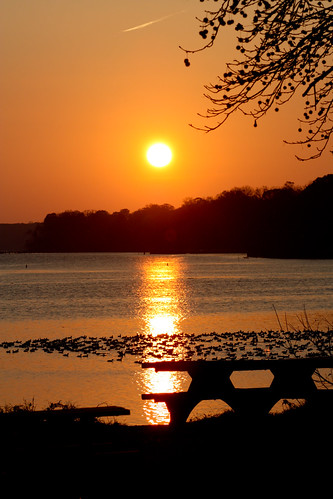
Riverside Park

Picnic Area at Riverside Park

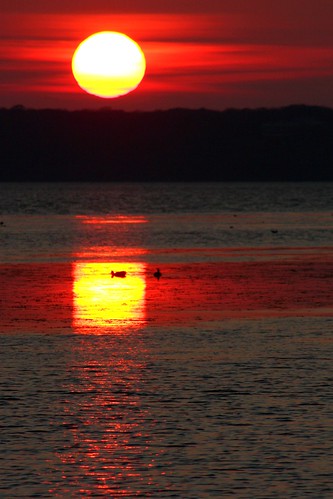
This evening I took my wife to watch the sunset at Riverside Park, along the Potomac River in Fairfax County, Virginia.

Sunset at Riverside Park

This is a great place for sunset photography.

Couple at the River Bank

Friday, June 5, 2009

El Yunque National Forest

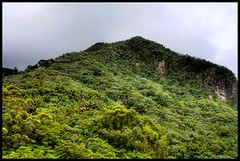
Today I visited El Yunque National Forest, the only tropical rain forest in the United States. I began at the park's visitor center, "El Portal Tropical Forest Center," which was a modern building with several exhibits, great views, and clean restrooms. I was also able to obtain a map of the park's roads and trails.

El Yunque Visitor Center

El Portal Tropical Forest Center

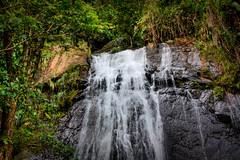
Heading south into the forest by car, the next stop was La Coca Falls, which are visible from the park road.

Cascada La Coca

Cascada La Coca

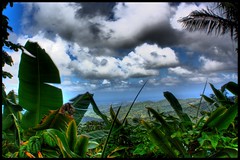
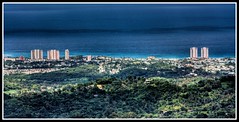
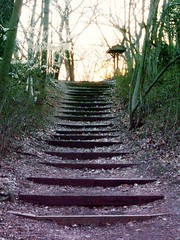
Headed further south, I took a short hike up Yokahu Tower, a scenic lookout just off the park road. Yokahu Tower offers views of the forest, the mountains and the ocean.

View From Yokahu Tower View From Yokahu Tower View From Yokahu Tower

Views from Yokahu Tower

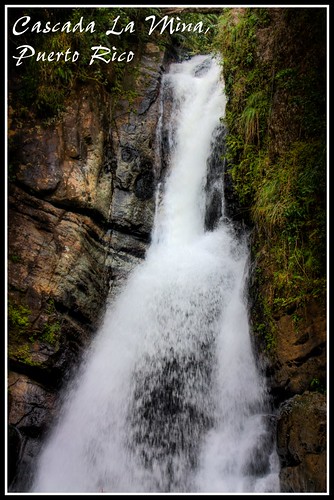
My last order of business in the park was a hike to La Mina Falls, one of the park's major attractions. The hike to the falls was a long, steady downhill slope. Along the way were several rain shelters and picnic pavilions. The trail along La Mina River was extremely crowded. Once I reached the falls, I joined a large number of tourists in swimming in the falls' natural pool. The water was refreshing, and allowed me to cool down before making the long walk back up the trail.

Cascada La Mina, Puerto Rico

Sunday, January 4, 2009

Proto-Chibchan Numerals

Reconstruction of an Ancient Central American Numeric System
Data from modern and recently extinct languages in the Chibchan language family is analyzed in an attempt to unravel the counting system used by the Proto-Chibchan people living in Costa Rica and Panama around the year 3000 BC.

Background
Proto-Chibchan is a hypothetical language, believed to have been spoken by Native Americans near present-day Costa Rica and Panama around the year 3000 BC. The Proto-Chibchan speakers were primarily agriculturists, who also engaged in pottery and boat-making.[1] Today, the Chibchan languages make up a language family indigenous to the Isthmo-Columbian area, which extends from eastern Honduras to northern Columbia and includes populations of these countries as well as Nicaragua, Costa Rica and Panama.[2]

Methods
Based on available data on the numerals used by contemporary Native American peoples speaking descendant languages of Proto-Chibchan,[3][4][5] I have used comparative techniques to deduce a rough approximation of the original Proto-Chibchan numeral system that can be traced down to modern Native American languages (many of which have expanded or modified the system significantly).

The following tree represents the normally assumed structure of the Chibchan language family,[1][2] with the specific languages compared in this article in bold:

Chibchan A
+Talamancan branch
++Teribe
++Viceitic branch
+++Bribri
+++Cabécar
+Borũca
+Waimí branch
++Ngäbere
++Bocotá
++Buglere
Chibchan B
+Pech
+Votic Branch
++Rama
++Maléku
+Dorasque branch
++Dorasque
++Chánguena
+Eastern Chibchan
++Kuna
++Colombian subgroup
+++Northern Colombian group
++++Chimila
++++Arwako group
+++++Kogui
+++++Southern and Eastern Arhuacan
++++++Ijca
++++++Guamaca-Atanque
+++++++Guamaca
+++++++Kankuamo
+++Southern Colombian group
++++Barí
++++Cundicocuyese
+++++Tunebo
++++++Central Tunebo
++++++Tunebo de Margua
++++++Tunebo de Manare
++++++Sínsiga
+++++Muisca-Duit
++++++Chibcha
++++++Duit

Aside from Chánguena, for which I was unable to obtain data other than the expression for the numeral 1, all known nodes of the Chibchan language tree are represented.

The First Five Numerals
Significant evidence from the daughter languages remains to reconstruct the Proto-Chibchan expressions for the numerals 2, 3, and 4, as well as two possibly related expressions for the numeral 5 in Proto-Chibchan A and Proto-Chibchan B. Diversity among the expressions for the numeral representing 1 among modern languages likely reflect subsequent innovations replacing the expression used at the time of Chibchan unity, thereby making it rather difficult (if not impossible) to reconstruct a Proto-Chibchan expression for 1 based on the data reviewed. A discussion of the various expressions used to represent numerals 6 through 10 is undertaken separately from the results demonstrated in this section, as the etymologies are somewhat more complex, and since the higher numerals raise some interesting issues better discussed separately.

The following table demonstrates my reconstructions for the Proto-Chibchan numerals:

1. undetermined
2. *búk(ə)
3. *maya
4. *paká(i)
5. undetermined (PCA: *chiká, PCB: *əchí)

Due to the limited data reviewed, and the inconsistencies of sources relied upon, many of which employ different orthographic systems to display their data, this reconstruction is admittedly a very rough approximation with a rather large margin of error. As more accurate input data become available, I hope to have opportunity re-evaluate my reconstructions.

The following sections demonstrate the intermediate results upon which I arrived at these reconstructions, i.e. intermediate reconstructions at each node of the Chibchan language tree.

Chibchan A
Linguists classify genetically classify the present-day (and recently extinct) Chibchan languages into two categories, A and B respectively, representing a linguistic split early in the Chibchan time line. Variants of these proto-numerals have persisted throughout both branches. The modern descendant languages of Chibchan A include those of the Waimí and Talamancan branches, as well as the Borũca language. Each is discussed separately below.

Waimí
The three Waimí languages investigated have very similar numerals for the numbers 1 through 5, enabling the following Proto-Wiamí reconstructions:

1. *ité (Ngäbere: di, Bocotá: de, Buglere: ite)
2. *búke (Ngäbere: bu, Bocotá: boke, Buglere: boke)
3. *mai (Ngäbere: mɔ, Bocotá: bai, Buglere: mai)
4. *bagá (Ngäbere: bɡɔ, Bocotá: baga, Buglere: baga)
5. *tiga (Ngäbere: riɡɛ, Bocotá: tiga, Buglere: tiga)

Talamancan
The Talamancan branch consists of the Viceitic languages and Teribe. I have reconstructed Proto-Viceitic as follows:

1. *ekra (Bribri: ek, Cabécar: ecra)
2. *buk (Bribri: bök, Cabécar: bur)
3. *mañá (Bribri: mañá, Cabécar: mañór)
4. *tkal (Bribri: tkël, Cabécar: tkil)
5. *skel (Bribri: skel, Cabécar: skel)

The forms in the Teribe language are as follows:

1. kra-rá
2. púg-da
3. myá-re
4. pkégn-de
5. shkégn-de

Combining Proto-Viceitic and Teribe results in the following Proto-Talamancan expressions:

1. *ekra
2. *buk
3. *mayá
4. *p'ka
5. *s'ke

Borũca
The following are the forms of the numerals in Borũca:

1. e'tsé
2. bú'k
3. mang
4. ba'kang
5. xi'kang

Chibchan A Results
Without using data from Chibchan B languages, the following reconstructions seem likely:

1. undetermined (Proto-Waimí: *ité, Proto-Talamancan: *ekra, Borũca: e'tsé)
2. *buk (Proto-Waimí: *búke, Proto-Talamancan: *buk, Borũca: bú'k)
3. *mayá (Proto-Waimí: *mai, Proto-Talamancan: *mayá, Borũca: mang)
4. *paká (Proto-Waimí: *bagá, Proto-Talamancan: *p'ka, Borũca: ba'kang)
5. *chiká (Proto-Waimí: *tiga, Proto-Talamancan: *s'ke, Borũca: xi'kang)

Chibchan B
The modern descendant languages of Chibchan B include those of the Votic, Dorasque and Eastern Chibchan branches, as well as the Pech language. Each is discussed separately below.

Votic
From the languages of Rama and Maléku, a unified set of Proto-Votic numerals can not be easily determined. However, the two languages appear to have some possible cognages with other branches of Chibchan B, upon which I made a few very weak reconstructions:

1. undetermined (Rama: saiming, Maléku: dooka)
2. *puk (Rama: púksak, Maléku: pángi)
3. *pan (Rama: pansak, Maléku: poóse)
4. *pakái (Rama: kungkungbi,Maléku: pakái)
5. undetermined (Rama: kʷikistar, Maléku: otini)

I also suggest the possibility that somehow the numbers two and three could have been reversed at some point.

Dorasque
With regard to the extinct language of Chánguena, I was only able to locate an expression for the numeral 1, i.e. "umai."

The numerals of the Dorasque language are as follows:

1. kue
2. mo
3. mas
4. paka
5. male

Pech
The Pech expressions for the numerals are as follows:

1. as
2. pok
3. mai
4. caa
5. aúnqui

Eastern Chibchan
The best documented Chibchan A data comes from the Eastern Chibchan or "Kuna-Colombian" language family. Due to the large number of languages compared, a series of trees demonstrating the numeral reconstructions at each node is perhaps the easiest way to demonstrate the results.

1. Proto-Eastern Chibchan: undetermined
Kuna: kwena
Proto-Colombian: undetermined
Proto-Northern Colombian: undetermined
Chimila: ti-tásu (ti is a prefix)
Proto-Arwako: undetermined
Kogui: éizua
Proto-Southern and Eastern Arhuacan: undetermined
Ijca: in'gwi
Proto-Guamaca-Atanque: *ishgua
Guamaca: ishgua
Kankuamo: ijkua
Proto-Southern Colombian group: undetermined
Barí: intok
Proto-Cundicocuyese: undetermined
Proto-Tunebo: undetermined
Central Tunebo: xesté
Tunebo de Margua: istan
Tunebo de Manare: ikti
Sínsiga: ikti
Proto-Muisca-Duit: *ata
Chibcha: ata
Duit: atia

2. Proto-Eastern Chibchan: *bókə
Kuna: po
Proto-Colombian: *bók(gw)a
Proto-Northern Colombian: *mógwa
Chimila: ti-múxuna (ti is a prefix)
Proto-Arwako: *mógwa
Kogui: mozhua
Proto-Southern and Eastern Arhuacan: *móga
Ijca: móuga
Proto-Guamaca-Atanque: *móga
Guamaca: móa
Kankuamo: moga
Proto-Southern Colombian group: *boka
Barí: insami (not a cognate)
Proto-Cundicocuyese: *bóka
Proto-Tunebo: *bukai
Central Tunebo: bukai
Tunebo de Margua: bukoï
Tunebo de Manare: bukai
Sínsiga: bukkai
Proto-Muisca-Duit: *bocha
Chibcha: boza
Duit: bocha

3. Proto-Eastern Chibchan: *máiə
Kuna: pa
Proto-Colombian: *mái(gw)a
Proto-Northern Colombian: *máigwa
Chimila: ti-máxana (ti is a prefix)
Proto-Arwako: *máigwa
Kogui: maigua
Proto-Southern and Eastern Arhuacan: *mái(gw)a
Ijca: máikeni
Proto-Guamaca-Atanque: *mái(gw)a
Guamaca: máigua
Kankuamo: ména
Proto-Southern Colombian group: *mái'a
Barí: tẽtahko (not a cognate)
Proto-Cundicocuyese: *mái'a
Proto-Tunebo: *mai
Central Tunebo: bay
Tunebo de Margua: maï
Tunebo de Manare: bai
Sínsiga: bai
Proto-Muisca-Duit: *mái'a
Chibcha: mica
Duit: meia

4. Proto-Eastern Chibchan: *məkaí
Kuna: pakke
Proto-Colombian: *makaí(gwa)
Proto-Northern Colombian: *makaígwa
Chimila: mbrí nyé (compound form, not a cognate)
Proto-Arwako: *makaígwa
Kogui: mukaiwa
Proto-Southern and Eastern Arhuacan: *makégwa
Ijca: ma'kéiwa
Proto-Guamaca-Atanque: *makégwa
Guamaca: makégua
Kankuamo: makéua
Proto-Southern Colombian group: *makái
Barí: ahduĩshkidã intok wa (not a cognate)
Proto-Cundicocuyese: *makái
Proto-Tunebo: *makái
Central Tunebo: bakaí
Tunebo de Margua: makaï
Tunebo de Manare: bagkai
Sínsiga: bakkai
Proto-Muisca-Duit: *muyhy'a
Chibcha: muyhyca
Duit: undetermined

5. Proto-Eastern Chibchan: *əchí
Kuna: attale
Proto-Colombian: *əchí(gwa)
Proto-Northern Colombian: *achígwa
Chimila: ti-ta (ti is a prefix)
Proto-Arwako: *achígwa
Kogui: juchiwu
Proto-Southern and Eastern Arhuacan: *achígwa
Ijca: aséwa
Proto-Guamaca-Atanque: *achígwa
Guamaca: achígua
Kankuamo: achíua
Proto-Southern Colombian group: *edzí
Barí: kobá (not a cognate)
Proto-Cundicocuyese: *edzí
Proto-Tunebo: *edzí
Central Tunebo: ezei
Tunebo de Margua: etsi
Tunebo de Manare: etsi
Sínsiga: edzí
Proto-Muisca-Duit: *hyz'a
Chibcha: hyzca
Duit: undetermined

Chibchan B Results
Without using data from Chibchan A languages, the following reconstructions seem likely:

1. undetermined (numerous forms in daughter languages, none bearing striking resemblance to any of the forms in other high-level branches)
2. *búkə (Proto-Votic: *puk, Dorasque: mo, Pech: pok, Proto-Eastern Chibchan: *bókə)
3. *máiə (Proto-Votic: *pan, Dorasque: mas, Pech: mai, Proto-Eastern Chibchan: *máiə)
4. *pəkái (Proto-Votic: *pakái, Dorasque: paka, Pech: caa, Proto-Eastern Chibchan: *makái)
5. *əchí (Maléku: otini, Proto-Eastern Chibchan: *əchí)

Comparison of Chibchan A and Chibchan B Results
The resemblance between the reconstructed numerals in the two branches is striking, and suggest the following reconstructions of the first five Proto-Chibchan numerals:

1. undetermined
2. *búk(ə) (from Proto-Chibchan A *buk and Proto-Chibchan B *búkə)
3. *maya (from Proto-Chibchan A *mayá and Proto-Chibchan B *máiə)
4. *paká(i) (from Proto-Chibchan A *paká and Proto-Chibchan B *pəkái)
5. undetermined (although there is likely some relation between the two expressions, I feel that there is too little data to determine whether the roots of Proto-Chibchan A *chiká and Proto-Chibchan B *əchí are cognate)

The only Chibchan language that does not use cognate forms of the reconstructions above is Barí, which appears to have adopted a different numeric system entirely. Perhaps worthy of note is the fact that Barí is one of only two Chibchan languages that is reportedly tonal.[6]

Six Through Ten
Most of the living and recently extinct Chibchan languages have forms for the numerals 6 through 10 that appear distinct from the numerals 1 through 5. Of the languages for which I was able to obtain data beyond the numeral 5, only Cabécar and Rama have numeric systems where the expression for the numeral 6 is merely a compound word with components indicating 5+1. In both languages, 7 is indicated by 5+2, 8 by 5+3, etc. Cabécar has a distinct expression for the numeral 10, whereas Rama expresses 10 as 5+5.

The fact that Cabécar and Rama stop at 5 and repeat tend to show that Proto-Chibchan probably only had distinct expressions for the numerals 1 through 5, whereas higher quantities were expressed using compound forms, if at all. Furthermore, since Cabécar is a Chibchan A language and Rama is a Chibchan B language, it is likely that the innovation of using distinct expressions for higher numerals occurred after the two sub-famlies became divergent.

That being said, a number of languages in both Chibchan A and Chibchan B appear to have distinct expressions for numerals 6 through 10, some of which have cognates on both the A and B side of the family. One possible scenerio explaining this seemingly paradoxical situation is that one or more extended numeric systems innovated in the daughter Chibchan languages was borrowed by other Chibchan languages, perhaps as a result of trade. Another possible scenario is that some of the daughter languages on both the A and B sides of the family borrowed expressions for numerals 6 through 10 from a common source. A third but in my opinion more remote possibility is a scenario where Proto-Chibchan had a numeric system with distinct expressions for the numbers 6 through 10, but for some reason or another, Cabécar and Rama lost these expressions perhaps after a long period where they were not often used.

Tunebo de Margua is an interesting language, and perhaps provides some clues. It uses expressions for the numerals 6, 7 and 8 that are cognate to those of other Chibchan languages, while 9 and 10 are represented by expressions meaning 8+1 and 8+2 respectively. All of the other modern Tunebo languages I have reviewed use a system that continues to 10 without the use of compounds.

Relationships Among Non-Compound Expressions for Six Through Ten
Excluding compound forms, all of the examined Chibchan expressions for the numeral 6 appear to have cognate roots with one-another:

6.
Ngäbere: ti
Buglere: dereke
Borũca: texén
Bribri: terl
Teribe: tér-de
Pech: séra
Kuna: nerkwd
Chibcha: taá
all Tunebo languages: terai
Guamaca: tainnúa
Ijca: chíngua
Kogui: taij-uña

Nicholas Ostler has proposed a Proto-Chibchan *ted-ua based on these forms.[7] For reasons stated above, I question whether such a reconstruction could be properly labeled Proto-Chibchan, considering the possibility that Proto-Chibchan did not have a non-compound expression for 6.

Moving on to expressions for 7, there is similar widespread simiilarity in expressions, spanning Chibchan A and B:

7.
Ngäbere: kɯɡɯ
Buglere: ɡuke
Borũca: kugtán
Bribri: cugl
Teribe: kógu-de
Kuna: kukle
Chibcha: cuhupqua
Central Tunebo: kukué
Tunebo de Margua: kuki
Tunebo de Manare: kukuni
Sinsiga: kukuí
Guamaca: kúgua
Kogui: kúgua

Exceptions which are clearly not cognate are Pech "tavuá" which may be a derivative related to "óva" (8), and Icja "shkába," also potentially a derivative related to "abéba" (8).

As we reach 8, the uniformity begins to erode. To represent the data, I grouped the expressions that are seemingly related, and indicated either and A or B to denote which side of the Chibchan family each expression falls on:

8.
Pech (B): óva
Central Tunebo (B): abé
Tunebo de Margua (B): avi
Tunebo de Manare (B): abi
Sinsiga (B): aví
Guamaca (B): ámbigua
Icja (B): abéba
Kogui (B): abi-kua

Ngäbere (A): kwɔ
Teribe (A): kwógu-de

Buglere (A): pa
Bribri (A): pagle

Chibcha (B): suhuza

Chimila (B): komá-na

Note that none of the groups span both Chibchan A and B, unless one or more of the groups can be combined. Such opportunity for combination is not apparent to me given the data.

The expressions for 9 are equally fragmented, although there is at least one group that spans Chibchan A and B:

9.
Ngäbere (A): ɤɡɔ
Buglere (A): inka
Guamaca (B): ihkágua
Icja (B): ihkágua
Kogui (B): kóga

Pech (B): tax (difficult to discern whether this expression belongs to the group)
Central Tunebo (B): estare
Tunebo de Manare (B): ettari
Sinsiga (B): stari

Teribe (A): shkówu-de

Bribri (A): sunito

Chibcha (B): aca

As expected, the expressions for 10 are across the board, as were those for 1 and 5. These numeric positions are particularly succeptable to replacement and innovation, as in addition to representing numerals, they may also express the ideas (such as the body parts upon which they were counted, for example). Forms that are not obvious compounds are listed only:

10.
Buglere (A): taboko
Bribri (A): d'bob
Cabécar (A): dobob
Teribe (A): dwówu-de

Pech (B): úca
Central Tunebo (B): ukafe
Tunebo de Manare (B): uteasi
Sinsiga (B): ukkasi
Guamaca (B): ugua
Kogui (B): uúga

Ngäbere (A): ni hɔdɔ

Maléku (B): paunka

Kuna (B): ampeki

Chibcha (B): ubchihica (probably a compound form of "hyzca" (5))

Chimila (B): che

Apparent cognate expressions for the numeral 10 do not span Chibchan A and B.


Irregularity in Kuna Compound Expressions for Eight and Nine
The numerals of the Kuna language deserve special attention, because the Kuna expressions for the numerals 8 and 9 have inexplicable compound forms:

1. kwena (unknown origin)
2. po (descendant of Proto-Chibchan *búk(ə))
3. pa (descendant of Proto-Chibchan *maya)
4. pakke (descendant of Proto-Chibchan *paká(i))
5. attale (unknown origin)
6. nerkwd (root is cognate to most common Chibchan form)
7. kukle (cognate to most common Chibchan form)
8. paapakka (lit. 3+4)
9. pakkepakka (lit. 4+4)
10. ampeki (unknown origin)

Paapakka for 8 appears to be a combination of pa + pakke (indicating 3 plus 4). Likewise, pakkepakka for 9 appears to be a combination of pakke + pakke (indicating 4 plus 4). As we all know, 3 plus 4 is 7 rather than 8, and 4 plus 4 is 8 rather than 9. I can not explain this apparent inconsistency.

Irregulary in Chimila Compound Forms
Chimila numerals also deserve attention, because they seem to belong to two classes, one of the classes consisting largely of unusual compound forms:

1. ti-tásu
2. ti-múxuna
3. ti-máxana
4. mbrí nyé
5. ti-ta
6. ráta mbrí nyé
7. ráta nyé
8. komá-na
9. ráta nyé
10. che

With the exception of the expression for 1, those numerals beginning with the prefix ti all appear to be cognate to Proto-Chibchan B. (Remember that the Proto-Chibchan B expression for 1 could not be determined.) However, the non-prefixed numerals for 4, 6, 7 and 9 appear to be compounds not based upon any of the Chibchan B forms. Furthermore, the expressions for 7 and 9 appear to be the same, unless the orthography used in the source from which these expressions were obtained did not catch a perhaps minute distinction. Of note, Chimila is a tonal language.[6]

Peer Review
As a general disclaimer to this article, I do not claim to have any formal linguistic training. I've read a few books on comparative linguistics, and seen a number of examples in practice. Furthermore, my methods and resources are assuredly not up to the standard of other linguists who have the luxury of a more complete lexicon of these languages and proper training. However, I have not found a thorough analysis of the Proto-Chibchan numerals anywhere else thusfar, so I set out to make this preliminary attempt to undertake the analysis.

Accordingly, I would love to have some review of my results by those in the field. Any and all comments, corrections, suggestions, additions, and even outright disagreements are absolutely welcome and encouraged by anyone with knowledge on this subject.

On a related note, I would like to give special thanks to Lloyd Anderson of Ecological Linguistics, who provided an extremely detailed critique of this article's first draft, based upon which I made numerous major edits, many of which resulted in what I feel are more accurate reconstructions. Mr. Anderson also provided a list of potential resources containing more data and insight (as well as a considerable amount of his own insight), which I intend to pursue prior to a planned second overhaul of this article.

References
1. American Indian Languages: The Historical Linguistics of Native America. Campbell, Lyle. 1997.
2. Wikipedia: Chibchan Languages
3. Numeral Systems of the World's Languages. Comrie, Bernard. 2008.
4. Native Languages of the Americas: Preserving and promoting American Indian languages
5. Numbers from 1 to 10 in Over 5000 Languages. Rosenfelder, Mark.
6. Evidence and Counter-Evidence. Lubotsky, Alexander.
7. U'wa, a dialect of Muisca. Ostler, Nicholas.

Saturday, March 1, 2008

Photographing Arlington's Parks

This week, I began a mission to photograph all of the nature parks in Arlington, Virginia over a period of a year. The plan, in addition to getting a lot of exercise, is to use the photographs to create merchandise and raise money for the upkeep of the county's parks. I expect to take between 5,000 and 10,000 photographs, as there are over 1,110 acres of parkland in Arlington. Pictured here is a trail in Potomac Overlook Park at sunset.

Wednesday, January 23, 2008

Khmu Culture

Khmu culture is traditionally passed down by the recital of stories around evening fires. The story-telling sessions involve the sharing of silver pipes (originally opium, but now predominately tobacco). Some Khmu are heavily tattooed for both decorative and religeous reasons. In Laos, Khmu are reputed for practicing magic, and some families still engage in the casting of spells and telling of fortunes. According to the animistic practices of the Khmu, reverence is offered to the house spirit Rroi gang. Villagers believe that a Khmu house, village, and its surroundings are integrated with the spirits of the land, and so houses and villages are considered holy or ritualized spaces. Typically, entire Khmu villages are enclosed in fences with three or four gates which separate the Khmu from their graineries and barns. Altars are placed outside the perimeter to ward off fires and storms. In the past, each Khmu family was believed to be under the protection of a totem such as a boar or an eagle who had originally helped an ancestor and would continue to protect the family. Traditional Khmu homes had two rooms, one for unmarried girls and one for the rest of the family. Roofs of houses covered with wooden tiles or thatch. Khmu cemeteries are traditionally divided into four sections; one for natural deaths, one for accidental deaths, one for children, and one for those who died away from home. The Khmu do not generally believe in rebirth. Traditional Khmu animism puts emphasis on the concept of taboo, as villagers believe that violations of taboo result in vengance of spirits. Forbidden activities include touching the altars or the amulets representing the house's spirit, birth ceremonies for children born feet-first, and entering a house without permission.

Wednesday, January 16, 2008

Sexual Harassment at # 35 in Pop Punk

Weekends With Dan's song "Sexual Harassment" is up to # 35 on Soundclick's Pop Punk chart, and is now the 5th song (out of 6) on Weekends With Dan's "Big Sexy Single" to chart. The band's first release "Anna Rexia" climbed to # 2 on the Pop Punk chart and reached # 6 on the broader Alternative genre chart. The acoustic "no meds remix" of "Anna Rexia" reached a maximum chart position of # 72. An earlier version of "Anna Rexia" also charted on GarageBand.com and MP3Charts.com in 2005. The "Ballad of Raggedy Andy" maxed out at # 42 on the Pop Punk chart, while "Ooh-ah (Wrinkles & Dimples)" made it to # 95. "Moon Over Miami" is the only song on the CD that has not yet charted.

Monday, January 14, 2008

Super Bowl Predictions

For this coming Sunday, the Giants have a 33% chance of beating Green Bay. Patriots should beat the Chargers with a predicted score of about 35 to 21. (Note that in the regular season week 2, Green Bay beat the Giants 35 to 13 and the Patriots beat the Chargers 38 to 14.)

Super Bowl odds:
---------------------
Green Bay 38%
Patriots 37%
Giants 13%
Chargers 12%

Friday, November 2, 2007

Origin of the Tai Peoples


Comparative linguistic research seems to indicate that the Tai people were a proto Tai-Kadai speaking culture of southern China, and that they, like the Malay-Polynesians, may have originally been of Austronesian descent. Prior to inhabiting mainland China, the Tai are suspected to have migrated from a homeland on the island of Taiwan where they spoke a dialect of Proto-Austronesian or one of its descendant languages. After the arrival of Sino-Tibetan speaking ethnic groups from mainland China to the island of Taiwan, the Tai would have then migrated into mainland China, perhaps along the Pearl River, where their language greatly changed in character from the other Austonesian languages under influence of Sino-Tibetan and Hmong-Mien language infusion. The coming of the Han Chinese to this region of southern China may have prompted the Tai to migrate in mass once again, this time southward over the mountains of southern China into Southeast Asia via the mountains of Burma and Laos to the north of Thailand. It is believed that the Tai ethnic groups began migrating southward from China and into Southeast Asia during the first millennium A.D. While this theory of the origin of the Tai is currently the leading theory, there is insufficient archaeological evidence to prove or disprove the proposition at this time, and the linguistic evidence alone is not conclusive. However, in further support of the theory, it is believed that the O1 Y-DNA haplogroup is associated with both the Austronesian people and the Tai.

Friday, October 19, 2007

Chao Phraya Watershed

The expanse of the Chao Phraya River and its tributaries, i.e. the Chao Phraya river system, together with the land upon which falling rain drains into these bodies of water, form the Chao Phraya watershed. The Chao Phraya watershed is the largest watershed in Thailand, covering approximately 35% of the nation's land, and draining an area of 157,924 km². The watershed is divided into the following basins:

*Pa Sak Basin
*Sakae Krang Basin
*Greater Nan Basin (comprising the Nan Basin and the Yom Basin, and usually divided as such in drainage analyses)
*Greater Ping Basin (comprising the Ping Basin and the Wang Basin, and usually divided as such in drainage analyses)
*Tha Chin Basin (the basin of the Chao Phraya's most significant distributary)
*Chao Phraya Basin (the land drained by the Chao Phraya River itself, and not by its major tributaries)

The mountainous natural boundary of the watershed forms a divide, which has, to some degree, historically isolated Thailand from other Southeast Asian civilizations. In fact, in northern Thailand, the divide roughly corresponds to a long section of the political border of present-day Thailand. Southern portions of the divide's boundary correspond less to the nation's political border, because isolation in this area was prevented by the ease of transportation along the lowlands surrounding the Gulf of Thailand, allowing a unified Thai civilization to extend beoynd the watershed without issue.

Wednesday, October 17, 2007

2007 Flooding in Phitsanulok, Thailand

Deforestation and urban development along the river banks in the region, combined with seasonal downpours in the Phetchabun Mountains have led to severe flooding in recent years within the province. Flooding in the province in 2007 was described by the Bangkok post as the worst floods in 40 years. On October 4, 2007, 100 rescue workers and 100 soldiers were dispatched to assist stranded residents in tambon Chompu and tambon Ban Mung, where water levels rose more than a meter. On that same day, Phitsanulok Governor Somboon Sripattanawat declared the Noen Maprang District a disaster zone. On October 6, 2007, Pongsagorn Kaenmanee, age 9 was among the first to drown in the flood waters. By October 8, 2007, the floods had killed at least three people in the Wang Thong District, and that district, in addition to Noen Maprang, was declared a disaster zone. On October 8, 2007, Deputy Prime Minister and Social Development and Human Security minister Paiboon Wattanasiritham visited the Phitsanulok Province to assess and address the flooding issues in the province. On October 10, 2007, the Office of Disaster Prevention and Mitigation sent boats out to deliver food and water supplies to residents of Bang Krathum District, which was cut off by floods. On October 12, 2007, the flooding took the life of a fifth villager in the province, who drowned after being swept away while he was rowing his boat to cast a fishing net. On October 14, 2007, flood water pressure sent inflows through the Mueang Phitsanulok Municipality's sewage system, flooding three communities. On October 15, 2007, the Royal Irrigation Department announced plans to construct six dams on the Wang Thong River as an attempt to solve the problem of seasonal flooding. On October 16, 2007 Thung Salaeng Luang National Park was temporarily closed for fear that tourists may become trapped in its caves by flood waters (This was prompted by an incident in Surat Thani's Khao Sok National Park where a group of cave exploring tourists drowned). A meeting of senior officials is scheduled for October 31, 2007 to discuss the progress of an environmental impact assessment (EIA) of the dam proposal. At least one of the dams will be in Thung Salaeng Luang National Park, but officials ensure that it will not be built in a wildlife sanctuary area. Flooding in the region is a recurring problem in Phitsanulok Province this time of year. In 2006, for example, between August 20 and December 13, over 22,000 people in 70 villages within Phitsanulok were affected by flooding, and over 1800 acres of farmland and 194 roads within the province were submerged by flood waters.

Wednesday, September 19, 2007

Jaras Makes ODP


Congratulations to my son Jaras who was accepted into the Olympic Development Soccer Program.

Monday, July 2, 2007

Weekends With Dan on iTunes


Weekends With Dan tracks are now available on iTunes.

Thursday, December 28, 2006

Conversational Old English

Wes thu hal. Here's a stab at conversational Old English. These are conversations related to asking for directions and dating/dining. The conversations don't necessarily take place in the Old English time period, as they often refer to streets with names (cognates of the names of the streets in my home town in Virginia) and even to the ficticious "Beowulf Restaurant." I don't think there were restaurants back then, so I went with the cognate for "food-hall." Diacriticals are omitted and the compound letter ae is denoted with the two letters a and e. I also used "th" instead of the thorn, to avoid text conversion issues. The content of these conversations is based on the Pimsleur language method.

Forgief me. Eart thu Engle?
Gea. Ic eom Engle. And thu?
Ic eom American.
Ac thu understandest Englisce.
Ae, ic understande hwon, ac ne forwel god.
Na, Ic þence thu forwel god sprecest.
Ic thancie the.

Forgief me.
Gea?
Hwaer is Heahlond Stret?
Heahlond Stret is thaer ofer.
And Willahelmessunu Stret?
Her is Willahelmessunu Stret.
And hu gaeth hit?
Me for? Forwel god. Ic thancie the. Far wel.
Far wel.

Wes thu hal, Hilda.
Wes thu hal, Aelfred. Hu gaeth hit?
God. Ic thancie the. Ac, ic wille hwa etan. Thu eac?
Na. Ic wille huru hwa drincan. (Meaning: No, I'd just like something to
drink.)
Hwaer? Willahelmessunu Stretan on?
Gea, god.

Forgief me, Hilda.
Gea?
Hwaenne wilt thu hwa etan? Nu?
Na, ne nu. Aefter. Ac, ic wille hwa drincan nu.
Hwaer? Me bi? (meaning: Where? At my place?)
Gea, georne.

Hilda, wilt thu etan nu?
Ic thancie the, Aelfred. Ne nu. Ac, ic wille hwa drincan.
Gea, god. Hwaet wilt thu drincan?
Ic wille win drincan. Na, na. Ic drinke beor.
Ic eac. Ic wille eac beor drincan.
(speaking to the waiter) Forgief me. Twa beor, ic bidde. Hu? Etan? Na,
ne nu. Aefter.

Wes thu hal, Hilda. Hu gaeth hit?
Hit gaeth god, Aelfred. Ic thancie the.
Saege, Hilda. Hwaet wilt thu don nu? (Meaning: Tell me, Hilda. What
would you like to do now?)
Ic? Ic wille hwa drincan. And thu?
Ic wille hwa etan nu. Wilt thu me mid etan?
Gea, ac hwaer? Thaet Fodahealaernan Beowulf aet?
Hwaer is þaet fodahealaern Beowulf?
Heahlond Stretan on.
Ae, gea. Ic cnawe hwaer hit is.
And ic wille eac beor drincan.
Gea, god. Ic eac.

Comments and corrections?

Far wel,
Kevin

Wednesday, August 23, 2006

Home Via the Breadbasket

Not much to say. Kansas is flat. Saw lots of farms. We'll be back home in Virginia in a few days.

Monday, August 21, 2006

Atop Mount Evans


My friend Sam Hansuld took me to the top of Mount Evans in Colorado. The weather was beginning to get stormy, but the view from the top made the trip worth it.

Saturday, August 19, 2006

Should Have Made a Left Turn at Albaquerque


Stopped in Albaquerque today. Wish I had alotted more time to stay here. The city has a nice old town with all kinds of shops and restaurants. We witnessed an outdoor wedding at the mission.

Wednesday, August 16, 2006

Idaho to the Grand Canyon in one day


Perhaps setting a new land speed record, we made it from Idaho to the north rim of the Grand Canyon in one day. I hadn't been here since 2000, when I visited the south rim. The ride in from the Kaibab Forest on the north side of the canyon was definitely more scenic, and there's a new lodge with shops and a nice restaurant. I definitely recommend the north rim over the south. Coming in through Utah was also worthwhile, as there were a number of national parks with all kinds of western landforms.